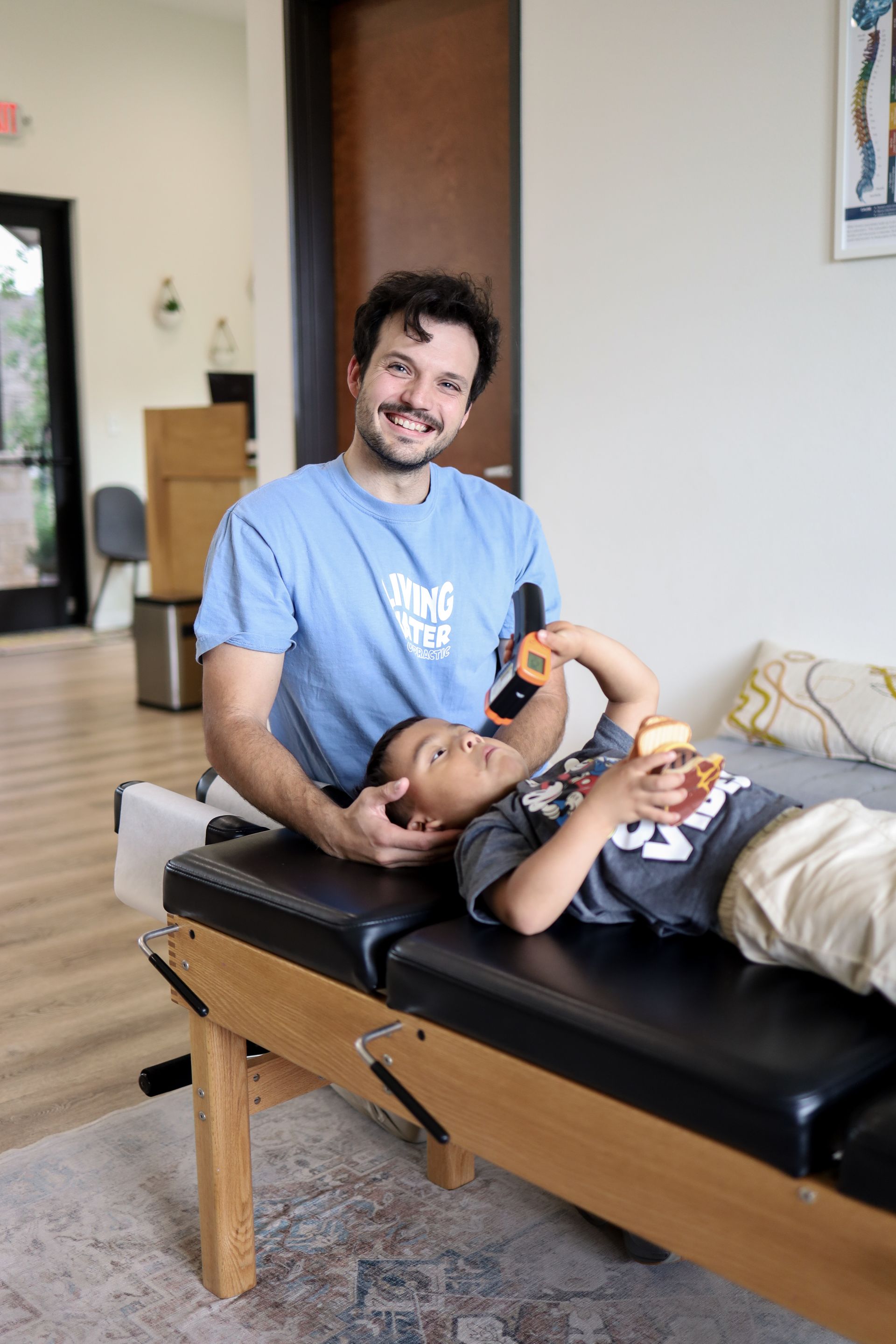
The Real Reason Stretching Isn’t Fixing Your Baby’s Torticollis
And what you can do instead!

If your baby’s head is stuck tilting to one side, you have probably been told it is just a tight muscle. Stretch it out, do some tummy time, and wait it out.
But here is what most pediatricians do not explain. Torticollis is not just about tight muscles. It is about what your baby’s nervous system experienced during birth.
You Are Not Alone in This
We see this story every week. A tired mom walks in holding a baby who cries during diaper changes, struggles to nurse on one side, and cannot get comfortable no matter what position you try.
At the two month checkup, the head tilt was noticed. You were referred to physical therapy and sent home with stretches that make your baby scream. You are doing everything you were told, yet nothing feels better.
Those stretches are not working because they are treating the symptom, not the root cause. While you are waiting and stretching, the subluxation in your baby’s upper spine is affecting much more than their neck. It can impact feeding, sleep, ear drainage, and developmental milestones.
Nathan’s Story: From Struggling to Thriving
Let us tell you about Nathan.
Nathan was born via an emergency C section that was traumatic for both mom and baby. He came to our office with torticollis, plagiocephaly or flat head, digestive struggles, and eczema covering his face. His spine was locked up from his neck all the way down to his lower back.
The tension in his neck caused ear misalignment, which led to repeated ear infections starting just a few months after birth. Occupational therapy was not helping. He had even been fitted for a helmet to correct the flat spot on his head, yet he still looked uncomfortable and unhappy all the time.
His nervous system was stuck in overdrive, and his body could not relax enough to grow and develop.
Within the first month of neurologically focused chiropractic care, Nathan’s digestive issues and eczema cleared. By the second month, everything changed. He began sitting up, crawling, pulling to stand, and he has not had a single ear infection since starting care.
Understanding Torticollis: More Than a Tight Muscle
1. Torticollis Is a Neurological Issue
When torticollis is diagnosed, the focus is usually on what is visible. A head tilt, tight muscles, and limited range of motion.
What often gets missed is what is happening underneath.
Torticollis is driven by subluxation. Subluxation includes misalignment within the neurospinal system, abnormal tension and fixation in those regions, and neurological interference that keeps the nervous system stuck in stress instead of calm coordination.
Think of it like a computer with too many tabs open. When the nervous system is overwhelmed by stress signals, the body cannot organize properly. Muscles stay tight, movement is limited, and your baby remains stuck in fight or flight.
2. Birth Trauma Is the Most Common Cause
Birth places a significant amount of pressure on a baby’s head and neck. Forceps, vacuum extraction, long labors, difficult positioning in the womb, and even C sections can create subluxation in the upper cervical spine.
When these stressors stack on top of each other, we often see what we call a perfect storm. The nervous system becomes overwhelmed and loses its ability to regulate and adapt.
3. Why Stretching Alone Often Fails
Stretching targets muscles, but it does not correct the neurological cause of the tension.
It is like trying to push a car while the parking brake is still on.
Many parents tell us the stretches make their baby cry and seem to make things worse. When the nervous system is already stuck in stress mode, added discomfort increases tension instead of releasing it.
When subluxation is gently corrected first, the nervous system can calm. Then stretches and positioning exercises finally become effective because the body is no longer fighting against them.
4. The Long Term Effects of Unresolved Torticollis
This is what concerns us most. When torticollis is not addressed at the neurological level, it does not always resolve on its own.
Subluxation can contribute to ongoing challenges such as ear infections due to poor Eustachian tube drainage, respiratory infections from difficulty moving mucus, and developmental challenges later on. These can include motor delays, sensory processing struggles, and attention issues.
When the foundation is unstable, every stage of development becomes harder.
There Is Hope and a Gentle Path Forward
If your baby has torticollis, you do not have to choose between painful stretches or waiting and hoping it improves.
There is a gentle and effective approach that addresses the root cause.
Advanced INSiGHT scans allow us to locate exactly where subluxation is present and how severe it is. With safe and gentle adjustments, tension can be released and balance restored to your baby’s nervous system. Many parents notice changes within just a few visits.
Sometimes our little ones are simply stuck in stress mode. When that nervous system tension is eased, everything can shift.
Ready to Help Your Baby Thrive?
At Living Water Chiropractic, we believe your baby deserves to feel comfortable, develop with ease, and thrive. You deserve to feel confident and supported along the way. Do not wait and hope torticollis resolves on its own. Call our office today to schedule a consultation for your baby.
If you are not local to us, visit the PX Docs directory to find a neurologically focused chiropractic office near you. We want to help your baby get unstuck and start thriving!