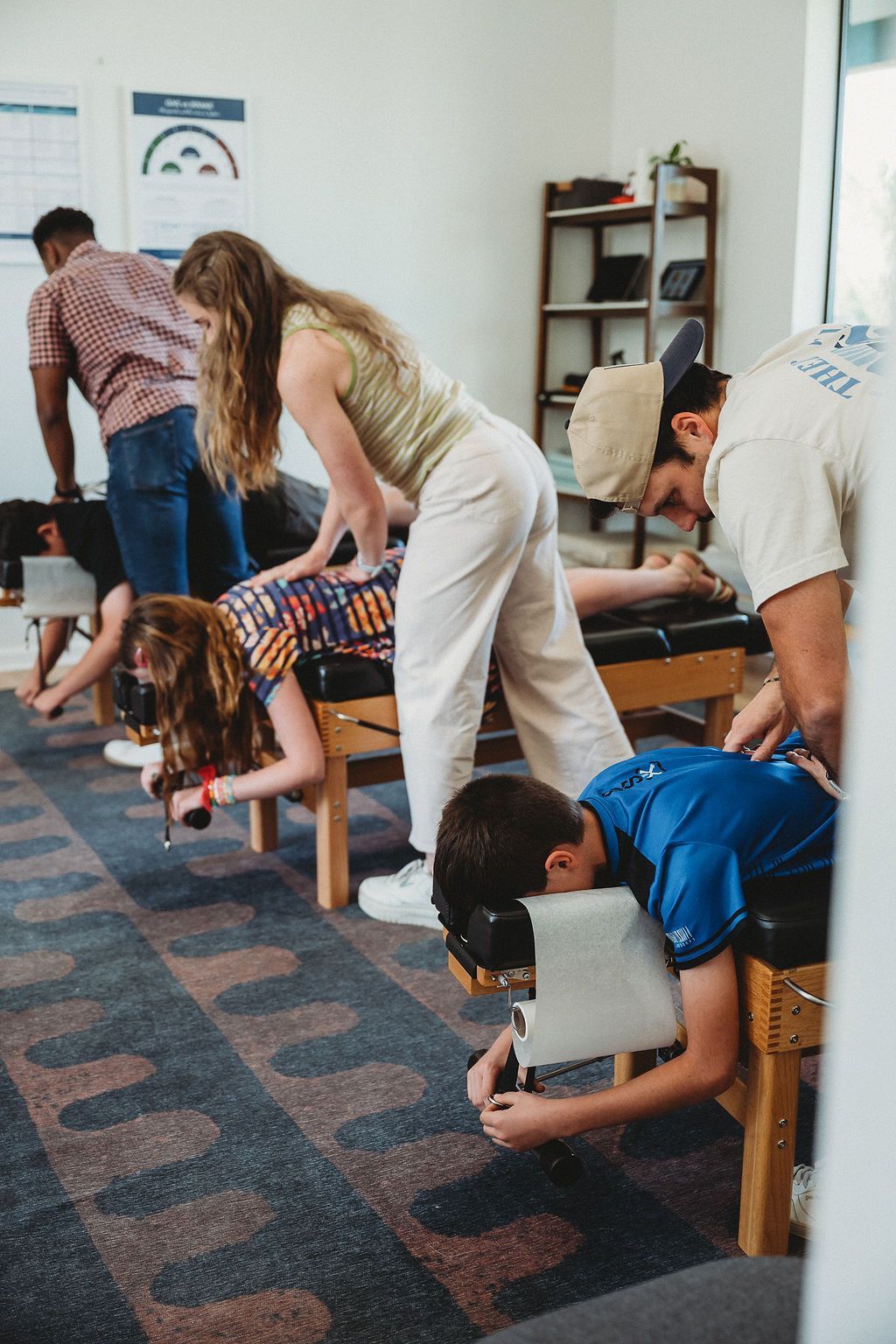
Your Child's 2 Minute Adjustment Is Doing More Than You Think
Every other healthcare experience has trained you to expect long appointments. So when your child's adjustment wraps up in under two minutes, it's completely natural to think — wait, that's it?

That's exactly the right question to ask. But the answer flips everything you've been taught about healing on its head.
If you've watched your child move through therapy after therapy, supplement after supplement, and still feel like something deeper isn't being reached — you're not imagining it. You're picking up on something real. And if you've ever sat in our Boerne office and wondered what those two minutes are actually doing, this post is for you.
A Story That Changes How You See This
One of the most powerful examples ever documented didn't happen in a chiropractic office. It happened in a Level 3 NICU.
A newborn had suffered a traumatic birth — whiplash to the upper neck and brainstem, a hypoxic brain injury, and a condition called Persistent Pulmonary Hypertension of the Newborn. Because that baby was connected to every monitor imaginable, the effect of those first gentle adjustments was visible in real time. His heart rate came down. His breathing improved. His oxygen levels rose. His whole body released the locked-in tension it had been holding since birth.
What happened in that NICU wasn't a one-time miracle. It's the same thing that happens quietly every time a child receives a neurologically-focused adjustment. You just can't see it spelled out on a screen.
We think about that story a lot when parents look up after a two-minute visit and say, "Is that really it?"
Yes. And also — so much more than you know.
What a Chiropractic Adjustment Actually Is
The first thing to let go of is the "pop" or "crack" sound. That's just gas releasing from joint capsules — it has nothing to do with whether the adjustment worked. Plenty of the most effective adjustments make no sound at all, especially with kids.
The real action isn't structural. It's neurological.
A precise input activates receptors packed into the muscles alongside the spine — the highest concentration of sensory nerve endings anywhere in the human body. That signal travels up the spinal cord to the brainstem, the cerebellum, and the prefrontal cortex, giving your child's brain a clean, accurate read on where their body is, how much tension it's holding, and what it needs to do to regulate.
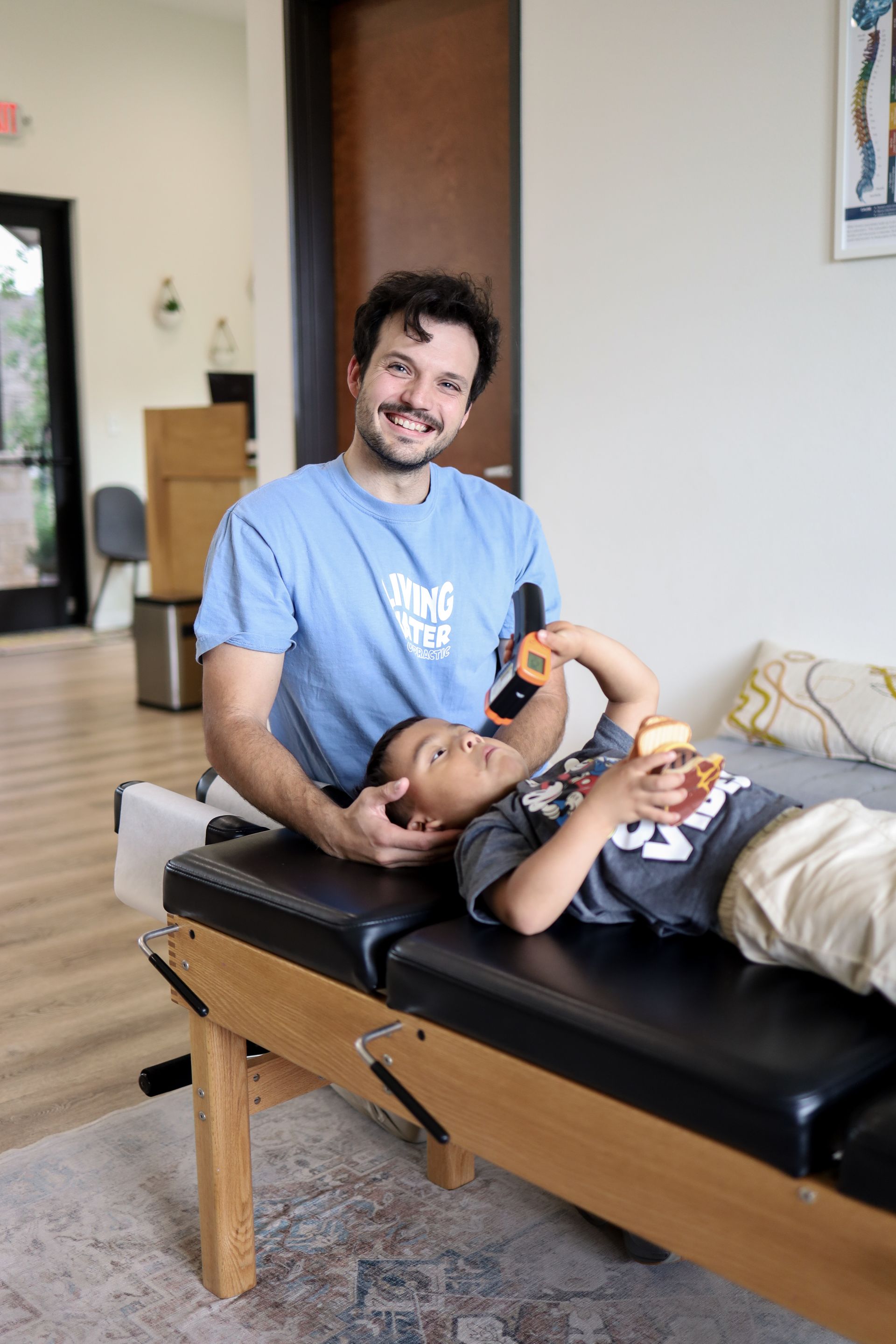
The goal is to correct what's called subluxation — a pattern of physical misalignment, restricted joint motion, and neurological interference between the brain and the body. For children, the pressure used is comparable to how you'd gently press an avocado to check if it's ripe. Gentle. Specific. Carefully calibrated to every stage of your child's development.
A neurologically-focused adjustment isn't shorter because it's doing less. It's shorter because of how powerfully — and immediately — the nervous system responds to precise input.
Why One Small Input Affects So Much
Parents often notice things after an adjustment that seem completely unrelated to the spine. Their child sleeps better. Digests more easily. Handles a hard moment at school with more flexibility than usual. Has a calmer evening.
This can feel baffling — until you understand that the nervous system controls all of it.
That adjustment signal reaches the brainstem: the region responsible for heart rate, breathing, digestion, and how calm or activated your child feels at any given moment. It engages the vagus nerve and the parasympathetic nervous system, helping the body shift out of the chronic fight-or-flight state that so many kids in our practice are stuck in when they first walk through the door.
Most dysregulated children aren't broken. Their nervous systems are stuck. And a neurologically-focused adjustment is one of the most direct inputs available to help shift that pattern.
The research supports this too. A 2016 study published in Neural Plasticity found that chiropractic adjustments produce measurable changes in prefrontal cortex activity — the region responsible for executive function, attention, and autonomic regulation. This is why children with very different diagnoses often share the same underlying nervous system pattern, and why working at the foundation level helps so many of them.
Why Two Minutes Is Exactly Right
Think of your child's nervous system like a computer with too many tabs open. When too many programs are running at once, everything slows down — or crashes entirely.
A child who is already stuck in sympathetic overdrive is being flooded all day: school demands, sensory input, screens, transitions, social stress, and everything else modern life throws at them. Adding 30 to 60 minutes of hands-on stimulation wouldn't be more thorough. It would be more load — and you've probably already seen what too much load looks like after a long therapy session or a busy afternoon.
A precise, targeted input takes roughly 90 seconds to two minutes. Then your child's brain spends the next 24 to 72 hours doing the real work — releasing stuck stress patterns, recalibrating, reorganizing. The adjustment is the spark. The healing happens in between visits, not during them.
Sometimes the most powerful thing we can offer an overloaded nervous system is less to process, not more.
Why Frequency Matters More Than Duration
The brain rewires through neuroplasticity — and neuroplasticity runs on one rule: repetition.
Research on neural change has consistently shown that repetition, specificity, and consistency drive lasting change — not the length of any single session. There are 168 hours in a week. Your child receives roughly six minutes of care across two or three visits. The other 167 hours and 54 minutes either work for them or against them.
This is why we talk about care plans rather than single appointments. Regular, consistent care keeps the nervous system's healing ahead of the constant reload from stress, growth spurts, illness, and sensory overload. The frequency is what builds the new pattern. The time on the table is just the catalyst.
This is also why families who commit to a consistent care window tend to see results that compound — and why the families who come in once and stop often feel like nothing shifted. One spark doesn't rewire a pattern. Consistent sparks do.
How We Know We're Working on the Right Thing
This is where neurologically-focused chiropractic care goes beyond guesswork — and it's one of the things we're most proud of at Living Water Chiropractic.
Before we adjust your child, we scan. INSiGHT scanning technology gives us three objective windows into how your child's nervous system is actually functioning:
Heart Rate Variability (HRV) shows how adaptable the autonomic nervous system is and reveals vagal tone — a key marker of how well your child's body can shift between calm and alert states. Low HRV is one of the clearest signs of a nervous system stuck in stress mode.
Surface EMG reveals whether your child is running their engine too hot — stuck with their foot on the gas — or showing fatigue patterns from a system that has been working overtime for far too long.
Thermal scanning maps where autonomic dysregulation is concentrated along the spine, showing us where the nervous system is working hardest to compensate.
Two children with the same diagnosis can show completely different scan patterns. That's why care at Living Water is personalized at the neurological level — not the symptomatic one. We don't guess at what your child needs. We measure it.
Your Child Doesn't Need More Labels. They Need Answers.
If your child has been through every protocol, every supplement stack, every therapy referral — and something still feels foundationally off — there's a reason for that feeling. The foundation is neurological. And the right input, delivered to the right place at the right frequency, is what actually shifts the trajectory.
You've been asking the right questions. You've been showing up for your child in every way you know how. We want to be the place that finally gives you a clear picture of what's happening underneath — and a plan that makes everything else you're doing start to work better.
Reach out to Living Water Chiropractic in Boerne today to get started. If you're not local to us, visit the PX Docs directory to find a neurologically-focused chiropractor near you.
Get the scans. Find the foundation. Trust the frequency.